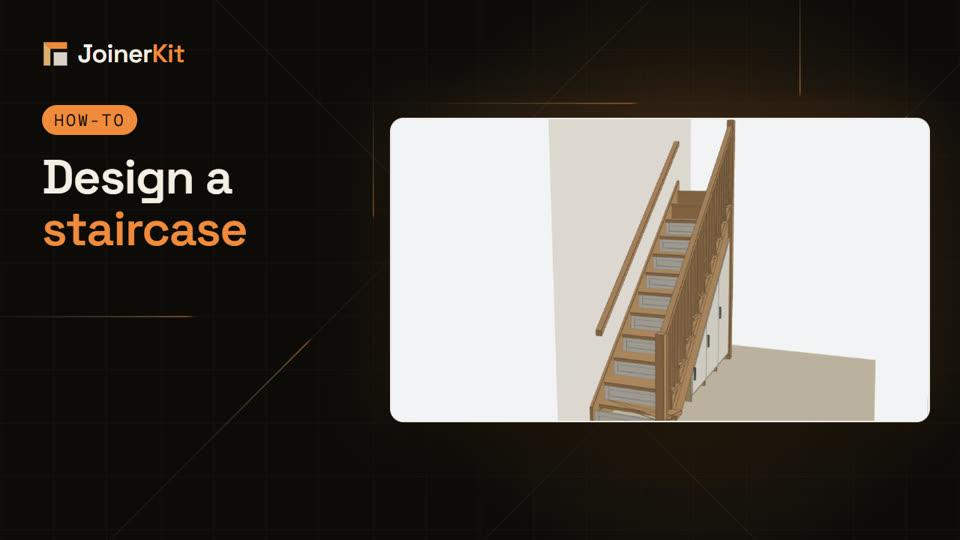
Stairs are in the Add list, with the doors and windows. Type the height from floor to floor and the stairs work out the rest: how many risers, each the same, and whether they meet the stair rules. Then choose the strings, a landing or winders, the balustrade, and drawers in the steps or cupboards under them. The cutting list, the price and the quote follow.
Step by step
Add the stairs
Press Add and choose Stairs. They're put on the wall you're looking at, their left side (as you go up) against it.
Say what they're for
Used as: A staircase between floors is checked against the stair rules (Part K in England, the IRC in America, the NCC in Australia). Furniture steps, up to a loft bed or a platform, aren't.
Type the rise, going and width
Floor to floor is shared equally between the risers. Leave Risers empty to have the fewest that meet the rules worked out, or type your own. The line under the boxes says the rise of each step, the treads, the pitch and how far it runs along the floor.
Choose its sides
Under Strings, each side going up: Against the wall, Closed (the treads and risers housed into it), Cut (sawtooth, the treads sitting on it) or None, an open side. With a landing or winders, Past the turn gives the second flight its own sides.
Add what it has
Treads and risers (the nosing, open risers, a bullnosed bottom step) and Balustrade; under More options, Landing or winders, Drawers in the steps and Under the stairs.
The stair rules
A staircase between floors is checked by the same sums as the free staircase calculator: the rise of each step, the going, twice the rise plus the going, the pitch and the gaps between the spindles (in England, no gap a 100mm ball can pass, so 99 or less; in Australia 125mm, so 124 or less). In Australia, no flight can have more than 18 risers: a taller stair needs a landing, and the Auto fix puts one in. Anything that isn't met is a warning on the Checks tab, and its Auto fix chooses the risers and going nearest yours that meet every rule. Winders are checked for their going at the middle of the stair, and widened if they need it. New Zealand's stair rules aren't checked yet (an account paying in NZ$): the card says so, and you check them yourself.
Strings, treads and risers
Each tread stands past the riser below it by the nosing, and past an open side by Past an open side. A housed string has to be wide enough for the steps: 50mm of it above the nosings and 25mm under the deepest housing. A narrower one is a warning, and its Auto fix chooses a wider timber, or a board to cut the strings from as wide as they need. Each country's Materials list has a stair string, a tread board, a newel post and a handrail. A tread wider than its timber is glued up from as many boards as it takes.
Landings and winders
A quarter landing turns the second flight 90° left or right; a half landing turns it back the way it came, beside the first, 100mm apart. Either stands on posts from the floor, with one newel at the inside corner. Winders turn a quarter in three tapered treads instead, two steps up as they turn, housed into a newel at the inside corner: they save the room a landing takes. At riser sets where the turn is (empty for halfway).
The second flight has the same sides as the first unless you choose otherwise under Strings (Past the turn, left and right). That suits stairs in a corner or a stairwell, with a wall past the turn too. Turning away from a wall out in the room, set that side Closed and put the balustrade on it.
Drawers in the steps, and units under the stairs
Drawers in the steps can come through the risers, in every flight: each drawer's front where its riser was, its box running back under the steps above as far as one of your runners fits, and a cheek under each string, cut to the pitch, to fix the runners to. The top step or two of each flight have no room behind them, and the card says which steps can take a drawer. Or choose From the side, stacked under each step: a box stair, a column under each step with its drawers stacked one to each riser's height, opening on its open side (choosing it takes the string off that side).
From step and To step choose which steps have them. Front style is Flat or Shaker (the shaker panels from the job's panel board), and To open them is Push to open (a latch behind each front, nothing to catch a foot) or Handles, the job's or one of your own. Each step's depth, front to back, lets you make any step's drawers shallower than the longest runner that fits. The boxes come from the job's drawer board, the cheeks and dividers from its carcass board.
Under the stairs fits units under the first flight, side by side from where there's room for one up to the top: Cupboards or Pull-outs with their tops sloping to the underside of the strings, or Drawers, chests stepping up under it. With drawers through the risers they go under the drawers' cheeks, so you can have both. It needs the stairs standing against their wall, and not a box stair: if something's in the way, the section says what. They're units of their own, to change as any unit, and they don't follow the stairs: change the stairs, then press one of the buttons again. If a change brings the stairs down into one, the Checks tab says so and its Auto fix brings its top back down under them.
Questions
How many risers will my stairs have?
For a staircase between floors, the fewest that meet the rules: in England each rise at most 220mm, so 2600mm floor to floor is 12 risers of 216.7mm. Type a number in Risers to choose your own. There's always one tread fewer than risers, as the top riser steps onto the floor above.
Can I put stairs up to a loft bed or a platform?
Yes: choose Furniture steps under Used as, and type the height to the platform as Floor to floor. They aren't checked against the stair rules, and drawers in the steps make good storage.
Why does it say my winders don't meet Part K?
Part K measures a tapered tread's going at the middle of the stair. Three winders in a stair 860mm wide give about 209mm there, under the 220mm it wants: the Auto fix makes the stairs wide enough, or choose a quarter landing.